In a city known for political authority and wealth, Ward 8 residents constantly struggle to access food, one of life’s most basic needs. With just one grocery store to serve the community, the lack of affordable fresh food options is a constant reminder of the inequalities that continue in Washington, D.C.
Food insecurity is a constant issue, particularly in Ward 8, where access to grocery stores is limited.
Despite having a population of over 70,000, Ward 8 only has one full-service grocery store, making this ward the most underserved. At the same time, Ward 3 has up to 15 grocery stores with similar population sizes. Unfortunately, with the high poverty rates, nearly 35% of residents in Ward 8 live below the federal poverty line, which adds to their inability to access healthy, affordable food. The need for local grocery stores and transportation options leaves many residents to rely on corner stores. Community organizations, government programs, and local initiatives are working to prevent this gap from widening, but the struggle for food access remains urgent. At the same time, some struggle with convenience, others with survival.
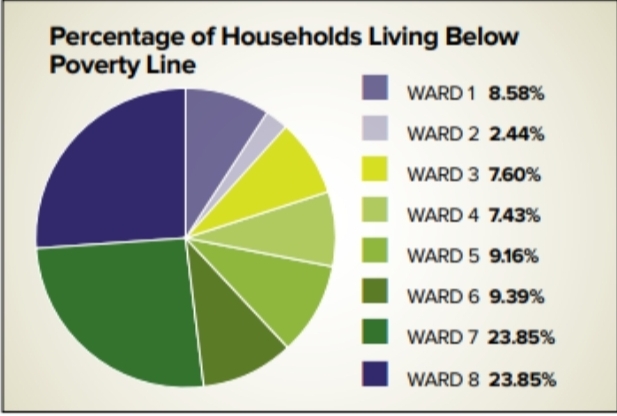
Percentage of households living below the poverty line across Washington, D.C.’s wards, highlighting Wards 7 and 8 as having the highest rates at 23.85%. The report is from the 2024 DCHS Minding the Grocery Gap Update.
Residents like Jahvon Gordon paint a picture of his daily struggle: “It’s not a kind space nor considerate for the families that commute and often make stops for groceries. Considering many are walkers, and some commute via the bus/train. The most convenient places to buy food are only from the carry-outs, corner stores, and or the Starbucks. None of which produces healthy living for the parents and students Ward 8 serves. My suggestions for being a fresh food trucks that align itself within proximity to high-traffic commuter areas. I have a slew of other thoughts about what’s possible,” said Gordon.
The ward residents must rely on fast food or travel to find fresh and nutritious options. Especially for
those without a car, it can be much more challenging. Former resident December Hamlet states, “When I stayed in Ward 8, there were limited grocery options unless you drove. Otherwise, you’re taking a minimum 30-minute metro commute to get fresh groceries. The grocery store food options are limited as well. Stores tend to be neglected a lot more. I literally used to go from SE to NE to get better options and shop in a cleaner environment.”
Unfortunately, food insecurity in Ward 8 isn’t an unknown issue; it has been documented many times
before, although more is needed for residents to see progress.
A recognized nutrition and food security expert, Dr. Goulda Downer, stated, “What we’re looking at in terms of policy around food deserts, I think it really, it really is, if you ask me: a blessing on the
leadership of our city. We have pockets of individuals who don’t have access, and others who have more than enough. You know, you’re essentially drinking from their saucers because their cops are overflowing, and in other areas, there is nothing, there’s nothing, and again, the story is that there’s 40% under the age of 19, that is a story in Ward 8. That’s our next generation, and we have to help them safeguard their health.”
Researchers and residents have long recognized the food insecurity crisis in Ward 8. “The City
Government is aware of same, and numerous national studies have also shown that certain urban
communities lack reasonable access to fresh food at reasonable prices, and traveling to obtain same is
very challenging,” said Terry H. These challenges continue to spark frustration in the community as they wait for someone to create these necessary changes for this community and address systematic equalities.
Another resident, Faith Deveaux, stated another concern: “I thought [about] Arcadia went out there to bring food. I don’t see any places to buy groceries, and I don’t know how anybody who lives there does. I don’t even see where grocery stores would be placed. It’s tragic, said Deveax.
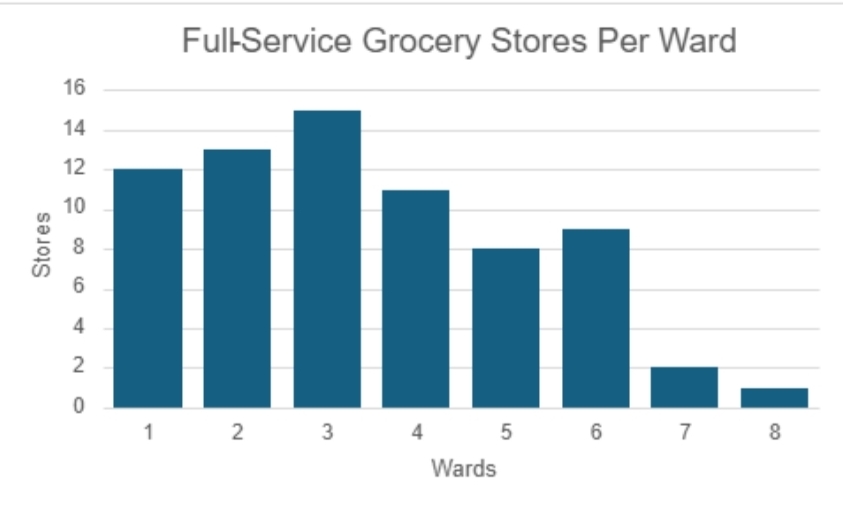
This illustrates the number of grocery stores in each Ward in Washington, D.C. Ward 3 has the highest number of stores (15), while Ward 8 has the lowest (1). The information is gathered from the 2024 DCHS Minding the Grocery Gap Update.
Expert Dr. Downer emphasizes that more than building more supermarkets is needed to address food
insecurity, especially if it is not in the right areas. ‘The policy is equity right, not equality right. They say that we should not allow any more supermarkets to be built anywhere unless it’s equitably distributed.” This highlights the importance of ensuring that new food resources are carefully planned and distributed to serve underserved communities rather than simply expanding access in already well-served areas where those are supported with more than enough, compared to Ward 8, which continues to call for help.
Efforts to provide mobile marts or pop-up food programs still need to address systemic issues. The lack of proper grocery stores and unreliable transportation continues to isolate the members of this community. “They need more bus service. I have been left waiting for a very long time at stops and not feeling very safe. On Metro Surveys, I make sure to state that they need to stop cutting service there and to increase it,” continued Faith.
Residents have also highlighted other concerns with Ward 8, from bus stops to a lack of investments in safety. Faith expresses her frustrations with the inequities and unresponsiveness of local leaders. “On
another note, I was regularly bringing flyers about our IT training, emailing the ANC’s and City Council members at Ward 8 about free training, and never get a response… They seem to have a lot of plans for an arts district, but not much else. I don’t know what their plans are to make it more livable there.”
Dr. Goulda Downer continues to ask the question that all Ward 8 residents wonder themselves, “You start to wonder if it’s an underserved area, and because so much has been put to there so, if all the services are there and several services are there, why is it not reaching the people who need it, right? The question becomes, where is the disconnect?”
As Ward 8 waits to grow, advocates hope food security takes priority. Ward 8 families deserve to eat fresh food, have options, and not feel forgotten by the city. The mission for Ward 8 continues for many in the community, but the bigger question is, how much longer must they wait for change?
 Tanaija Kee's Digital Portfolio
Leave a comment